Best-of comparison
Best Travel Apps 2026: 9 Picks for Planning, Tracking and Budget
Compare nine travel apps by what they do best: itinerary planning, route tracking, budgets, maps, bookings, privacy and travel memories.
Keep comparing
Narrow down the choice
These comparisons are the best match for the decision you are making now.
There is no single best travel app for every trip. Choose one app to own the core of the journey, then add specialist tools only for navigation, bookings, transport research or packing.
The nine picks below are organized by the job they do best. Start with your main source of friction: itinerary planning, private organization, route tracking, expenses, reservations, offline navigation, transport research or packing.
Best travel apps by need
Best private trip space
WanderSpend brings maps, timelines, documents, budgets and memories into one calm, private place.
Compare private travel appsBest travel tracking app
Polarsteps is strongest for automatic route tracking, visual storytelling and sharing a journey.
Compare Polarsteps and WanderSpendBest itinerary planner
Lambus suits planning-heavy trips; Wanderlog is especially strong for routes, reservations and collaborative itineraries.
Compare itinerary appsBest travel budget app
TravelSpend goes deepest on expenses; WanderSpend integrates budgeting into the wider trip.
Compare budget appsNine travel apps at a glance
Use-case matrix
You want one private place for your whole trip
WanderSpend
Maps, timeline, documents, notes, budget and memories stay together without turning the trip into a feed.
You want to automatically track your route
Polarsteps
Route tracking and visual trip sharing are the center of the experience.
You are building a detailed itinerary or road trip
Wanderlog
Places, route order, reservations and collaboration are stronger than in a general trip organizer.
You are planning a complex group trip
Lambus
Stops, itinerary, documents, expenses and collaboration share one planning workspace.
You mainly care about travel expenses
TravelSpend
Focused cost tracking, currencies, exports and budget analysis come first.
Booked reservations define the trip
TripIt
Flights, hotels and confirmation details become the master itinerary.
You need navigation and offline maps
Google Maps
Use it as the practical navigation layer beside your core trip app.
You are comparing transport options
Rome2Rio
Research trains, buses, ferries, driving and flights before saving the final route.
Packing is the main source of stress
PackPoint
Use a packing-list specialist as a small companion to the main trip app.
Four core travel apps compared
| Criteria | WanderSpendOur app | Polarsteps | Lambus | TravelSpend |
|---|---|---|---|---|
| Primary workflow | Private trip map, timeline, documents, notes, budget and memories | Plan, track, share and relive trips with automatic route capture | All-in-one trip planner for stops, itineraries, documents, expenses and group trips | Focused travel expense tracking and budget analysis |
| Best for | Travelers who want a calm private trip space | Travelers who want route tracking and visual trip sharing | Travelers who want structured itinerary planning and collaboration | Travelers who care most about detailed cost tracking |
| Map and automation | Manually add places and see the route on a private Trip Map | Automatically captures a route when Travel Tracker is enabled | Stops, routes and itinerary context are part of trip planning | Expenses can be connected with places and map context |
| Budget and documents | Expenses, shared costs, currencies, documents and notes | Stories and photos are central; not a dedicated budget app | Documents and expenses included; advanced exports and currencies require PRO | Strong expense tools; less focused on complete document organization |
| Pricing model | Completely free, without ads or subscriptions | Free core app; optional Polarsteps Plus subscription and paid Travel Books | Free base version with optional Lambus PRO | Free base version with optional Premium features |
| Privacy fit | Privacy-first, no ads, no tracking, offline-friendly | Visibility controls exist, but route tracking and sharing are central | Account-based planner with collaboration and cloud trip organization | Expense-focused app with account, sync and sharing features |
How to choose a travel app
Start with the part of travel that creates the most friction for you.
A solo backpacker who wants to track a route across countries needs something different from a family trying to keep documents, costs and plans in one place. A couple splitting expenses needs something different from a group building a detailed itinerary together.
The most useful question is not:
Which travel app has the most features?
A better question is:
Which app should own the core of my trip?
Once you know that, the choice becomes easier.
For international trips, also check the currency workflow rather than only the country where the app was developed. Travelers budgeting in AUD, GBP or CAD should be able to record a payment in EUR, JPY or another destination currency without losing sight of the home-currency total. WanderSpend supports these home currencies and keeps exchange rates, conversion and shared costs inside the trip.
Best for private trip organization: WanderSpend
WanderSpend is built as a private travel space.
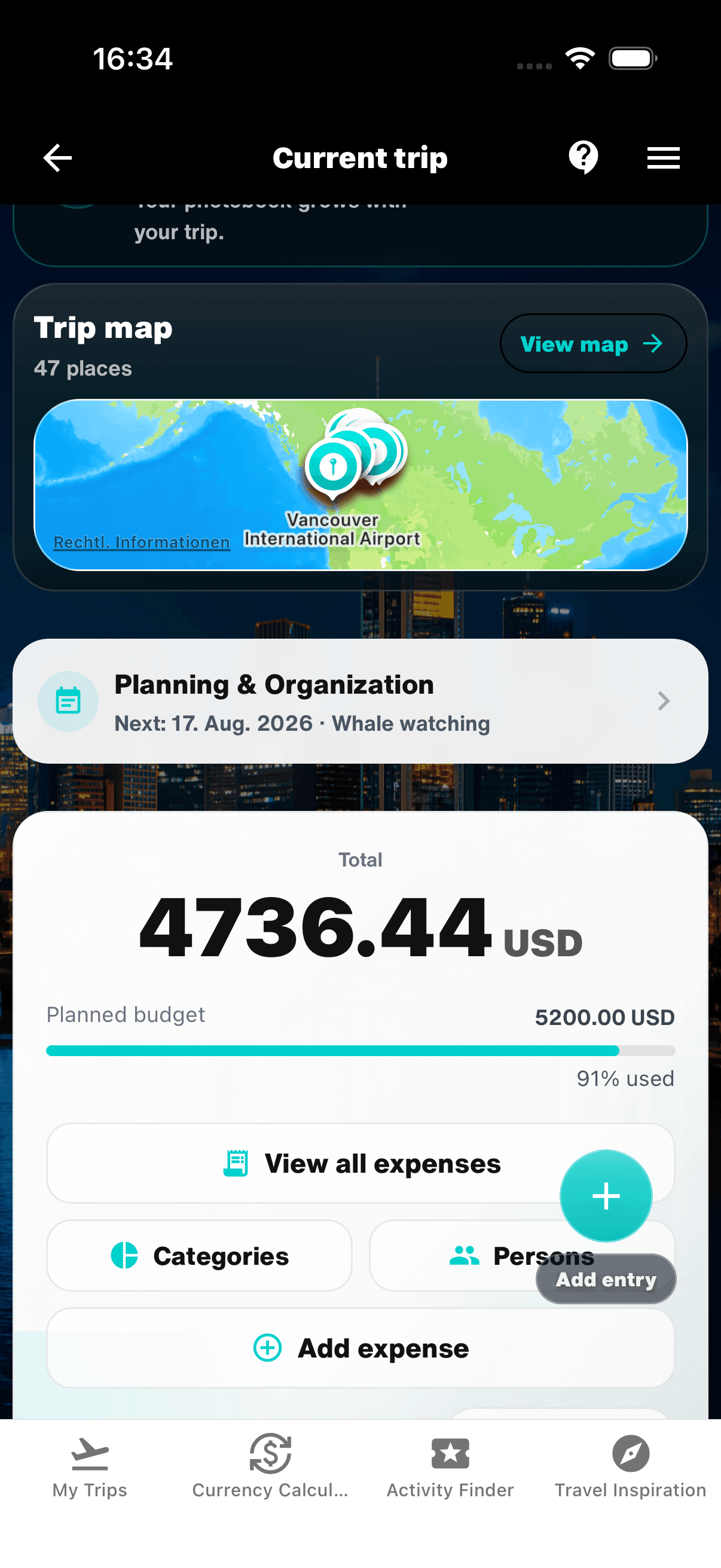
It brings together the parts of a trip that often end up scattered across different apps:
- places and Trip Map
- travel days and timeline
- documents and notes
- expenses and shared costs
- exchange rates and currency calculator
- favorite moments and Trip Memories
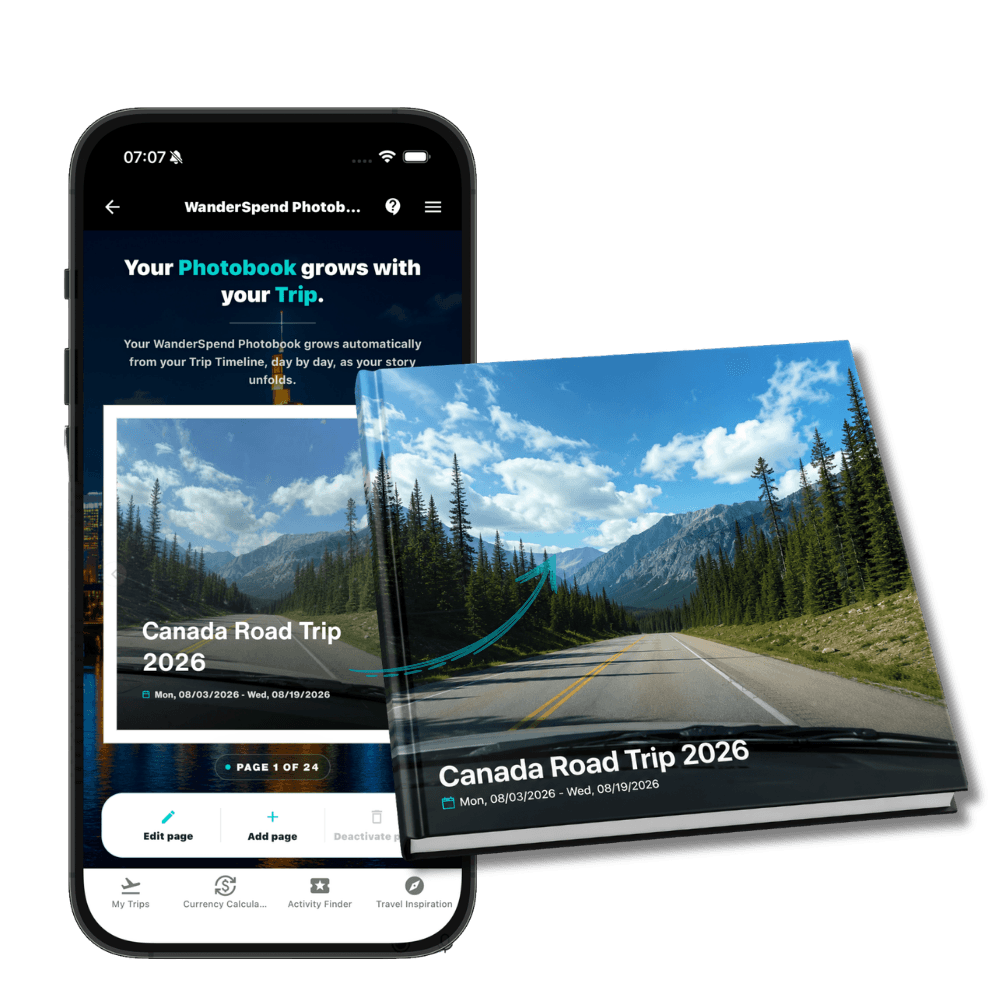
- a live photobook preview that develops as the trip grows
The budget tools are important, but they are not isolated from the rest of the journey. Costs sit next to the places, days, documents and memories they belong to.
That makes WanderSpend especially useful if you want one calm place for the whole trip, not a social feed and not a heavy planning dashboard.
WanderSpend is a good fit if you want to:
- plan a trip privately
- add places to a map
- follow your journey day by day
- keep documents and notes close
- track expenses and shared costs
- remember the trip afterward
Strengths
- + Strong private trip-space concept
- + Trip Map, timeline, documents, notes, budgets and memories in one place
- + Budgeting is connected to the whole trip context
- + Free, no subscriptions, no ads and privacy-first positioning
- + Good fit for travelers who want calm organization rather than social sharing
Limitations
- - Younger than established travel apps such as Polarsteps, Lambus or TravelSpend
- - Not built as a public travel social network
- - Not designed as an accounting-heavy finance dashboard
One private space for the whole trip

Best for travel tracking and sharing: Polarsteps
Polarsteps is one of the most established names in travel tracking.
It is highly polished and built around a clear idea: plan your trip, track your route, share your journey and relive it afterward.
That makes Polarsteps especially strong if your route itself is the travel story.
Its strengths include:
- automatic route tracking
- visual trip maps
- trip steps with photos and stories
- easy sharing with friends, family or followers
- privacy controls for accounts and individual trips
- Travel Books as a physical memory product
The core Polarsteps app remains free and ad-free. Its current business model also includes paid Travel Books, affiliate bookings and the optional Polarsteps Plus subscription for additional map, statistics and book features.
The trade-off is that Polarsteps is naturally more tracking- and sharing-oriented than a private organization app. If you enable the Travel Tracker, route capture becomes part of the experience. If you enjoy sharing your journey, that can be a major benefit. If you prefer a quieter private trip space, it may feel like more than you need.
Strengths
- + Very established and polished travel tracking app
- + Strong automatic route tracking and visual storytelling
- + Free core app without ads
- + Great fit for sharing journeys with friends and family
- + Travel Books offer a strong post-trip memory product
Limitations
- - More focused on tracking and sharing than private trip organization
- - Automatic tracking can affect privacy, background activity and battery use
- - Less focused on budgets, shared costs and travel finance workflows
- - Some extras now require Polarsteps Plus
For a narrower decision, see Polarsteps vs WanderSpend, FindPenguins vs Polarsteps or the wider guide to Polarsteps alternatives.
Best for planning-heavy trips and collaboration: Lambus
Lambus is a broad all-in-one travel planner.
It is closer to a full planning platform than a lightweight trip journal. Lambus is especially relevant when a trip has several stops, multiple people, bookings, tickets, transportation details and planning tasks.
Its strengths include:
- stops and itinerary planning
- documents, tickets and booking context
- expenses inside the trip
- group and collaborative planning
- web and mobile access
- advanced PRO features for planning-heavy trips
Lambus can be a better fit than WanderSpend if you want a more structured planning workspace, especially for group trips or complex itineraries.
The trade-off is that Lambus can feel more like a planning dashboard. That may be exactly what you need for complex travel. But if your goal is a calmer private space for maps, memories, notes and budgets, WanderSpend may feel lighter and more personal.
Strengths
- + Broad all-in-one planner for stops, documents, expenses and photos
- + Strong fit for collaborative group planning
- + Available on mobile and web
- + Good choice for planning-heavy itineraries
- + PRO adds advanced route, export, flight, currency and weather features
Limitations
- - Some advanced features require Lambus PRO
- - Can feel more planning-dashboard-like than calm private travel space
- - Less focused on personal post-trip memories as the core product experience
Best for focused travel expense tracking: TravelSpend
TravelSpend is one of the clearest choices if your main problem is travel spending.
It focuses on helping travelers track costs, understand their budget, work with currencies, split expenses and analyze where money goes during a trip.
That makes TravelSpend a strong fit for:
- long-term travelers
- backpackers
- couples
- group trips
- people who care deeply about expense details
- travelers who want cost analysis more than travel journaling
TravelSpend can go deeper into expense tracking than broader travel planners. Features such as exports, custom categories, debts, own exchange rates, unlimited active trips and monthly statistics are part of its more advanced Premium layer.
The trade-off is clear: TravelSpend is stronger if the trip is mainly a cost-control problem. WanderSpend is stronger if budgeting is only one part of a wider private travel space with maps, documents, notes, timeline and memories.
Strengths
- + Focused travel expense and budget app
- + Strong fit for travelers who care deeply about cost tracking
- + Useful for shared costs, currencies and budget analysis
- + Good choice for long trips and group expense workflows
- + Advanced Premium features support more detailed analysis
Limitations
- - Several advanced features require Premium
- - Less focused on maps, documents, notes and memories as one private trip space
- - More expense-oriented than travel-story-oriented
Other useful travel apps by use case
The four apps above are the core comparison set for this TravelHighlights section because they overlap most clearly with planning, tracking, budgeting and private trip organization.
For a real trip, though, you may also want specialist tools around that core app.
Best for detailed itinerary building: Wanderlog
Wanderlog is useful when your main task is building an itinerary before departure.
It is a stronger fit than a private trip organizer when you need route planning, road trip stops, reservations, collaboration and a planning workspace across web and mobile. Start with the guide to the best travel itinerary apps and templates, then use the direct Wanderlog vs WanderSpend comparison or the broader best Wanderlog alternatives guide for a narrower decision.
Best for reservation organization: TripIt
TripIt is relevant when the trip is mostly defined by bookings.
Instead of planning every sightseeing stop, TripIt helps organize travel plans and itinerary details around flights, hotels, car rentals and reservations. It can be a good companion app for business travel, city breaks or any trip where confirmations are the main source of truth.
Best for navigation and offline maps: Google Maps
Google Maps is usually not the emotional core of a trip, but it is often the practical map layer.
Use it for navigation, saved places, local discovery and offline maps in supported areas. It works best next to a core travel app rather than as the place where documents, budgets, notes and memories live.
Best for transport research: Rome2Rio
Rome2Rio is helpful before the itinerary is fixed.
It is strongest when you need to understand how to get from one place to another by train, bus, ferry, car or flight. Once you choose the route, save the final plan in your core trip space so transport decisions do not disappear into browser tabs.
Best for packing lists: PackPoint
PackPoint is more specialized than the other apps in this guide. Its job is packing-list support, not trip planning or budgeting.
That can still be useful if packing is the stressful part of your workflow. Treat it as a small helper around your main travel app, not as the place that owns the trip.
Should you use one travel app or several?
You do not always need one app to solve every travel problem.
Many travelers use a small stack:
- one app for the core trip space
- one app for bookings or transport
- one app for navigation
- one app for messaging or sharing
The danger is not using several apps. The danger is not knowing which app owns the important trip information.
If your trip information is scattered across notes, screenshots, PDFs, bank apps, spreadsheets and chat messages, it becomes harder to find things when you actually need them.
That is why a core trip space matters.
For some travelers, that core space is Polarsteps because the route and sharing are the story.
For others, it is Lambus because collaborative planning is the main workflow.
For budget-focused travelers, it may be TravelSpend.
For travelers who want a calmer private space with maps, documents, notes, budgets and memories, it can be WanderSpend.
Final verdict
The best travel app is not the same for every traveler.
Choose Polarsteps if you want polished travel tracking, visual route storytelling and sharing.
Choose Lambus if you want a planning-heavy all-in-one itinerary tool with collaboration, web access and advanced planning features.
Choose TravelSpend if your main priority is focused travel expense tracking and cost analysis.
Choose WanderSpend if you want your trip to live in one calm private space — with places, Trip Map, timeline, documents, notes, expenses, shared costs, currencies and memories.
The short version:
- WanderSpend: best for private trip space
- Polarsteps: best for route tracking and sharing
- Lambus: best for planning-heavy collaboration
- TravelSpend: best for detailed travel budgeting
- Wanderlog: best for itinerary-building and road trip planning
- TripIt: best for reservation organization
- Google Maps: best for navigation and offline maps
- Rome2Rio: best for transport research
- PackPoint: best for packing lists
Related travel app comparisons
Best Travel Journal Apps: Polarsteps, FindPenguins, Journi and WanderSpend
The right travel journal app depends on whether you want automatic tracking, route files, social sharing, a flexible photo journal or a private trip space.
Journi Blog vs WanderSpend: Travel Journal and Photo Book Compared
Journi Blog is a flexible photo-journal and print ecosystem; WanderSpend is a private trip space whose photobook preview grows during the journey.
Best Private Travel Apps for Planning, Budgets and Memories in 2026
Private travel apps should make trips easier without turning your journey into a public feed. This guide compares private-first organization, tracking, maps, budgets and booking workflows.
FindPenguins vs WanderSpend: Travel Journal or Private Trip Space?
FindPenguins turns routes, Footprints and photos into a shareable travel journal, while WanderSpend keeps maps, timelines, documents, budgets and memories in a private trip space.
Wanderlog Cost 2026 vs WanderSpend: Free or Pro?
Wanderlog Free covers core itinerary planning; Pro adds offline access and advanced route tools. Compare both with WanderSpend's free private trip space.
FAQ
What is the best travel app overall?+
There is no single best travel app for every traveler. The best choice depends on whether you need private trip organization, route tracking, collaborative planning, expense tracking, documents or memories.
Should I use one travel app or several?+
Many travelers use one core trip app and one or two specialist tools. The important part is avoiding duplicated information and unclear ownership of your travel data.
Which travel app is best for budgets?+
TravelSpend is a strong fit for travelers who mainly want detailed expense tracking. WanderSpend is a better fit if you want travel budgeting inside a broader private trip space with maps, timeline, documents and memories.
Which travel app is best for sharing a journey?+
Polarsteps is the clearest fit if route tracking and sharing your journey with friends, family or followers are central to your travel workflow.
Sources and verification notes
Official WanderSpend product positioning and public app links.
Last checked: 2026-08-12
WanderSpend Apple App Store listing
Official iOS listing used to verify public store availability and product positioning.
Last checked: 2026-08-12
WanderSpend Google Play listing
Official Android listing used to verify public store availability and product positioning.
Last checked: 2026-08-12
Official Polarsteps positioning, product features, scale, travel tracking, sharing and travel book information.
Last checked: 2026-08-12
Polarsteps Help Center - Is Polarsteps free?
Official information about the free core app, Polarsteps Plus, Travel Books and affiliate bookings.
Last checked: 2026-08-12
Official details for the optional Polarsteps Plus subscription and its additional features.
Last checked: 2026-08-12
Polarsteps Help Center - Privacy and trip visibility
Official account and trip privacy controls.
Last checked: 2026-08-12
Official Lambus positioning, all-in-one planner features, group planning, app and web availability.
Last checked: 2026-08-12
Official Lambus PRO feature page used to verify advanced route planning, expenses export, PDF export, flight updates, foreign currencies and weather updates.
Last checked: 2026-08-12
Official TravelSpend positioning, expense tracking, offline use, currency conversion, insights, map and export information.
Last checked: 2026-08-12
TravelSpend Premium help article
Official Premium feature list including CSV export, own exchange rates, unlimited active trips and monthly statistics.
Last checked: 2026-08-12
Official Wanderlog positioning for itinerary planning, road trips, maps, collaboration and web/mobile use.
Last checked: 2026-08-12
Official Wanderlog Pro page used to verify the existence of a paid Pro layer and related product context.
Last checked: 2026-08-12
Official TripIt positioning for organizing travel plans and itineraries.
Last checked: 2026-08-12
Official Google Maps positioning for navigation, places and maps.
Last checked: 2026-08-12
Google Maps Help - Offline maps
Official Google Maps help page used to verify offline map support.
Last checked: 2026-08-12
Official Rome2Rio positioning for comparing transport routes and travel options.
Last checked: 2026-08-12
Official App Store listing used to verify packing-list app positioning.
Last checked: 2026-08-12